Manufacturer · Wolf
Wolf
Wolf is the cooking half of the same manufacturer as Sub-Zero, and in most of these kitchens the two were specified together — so it is worth setting out how Wolf equipment actually fails, and why the diagnosis runs differently from a mass-market range.
Burners
Clicking, low flame and a burner that will not stay lit
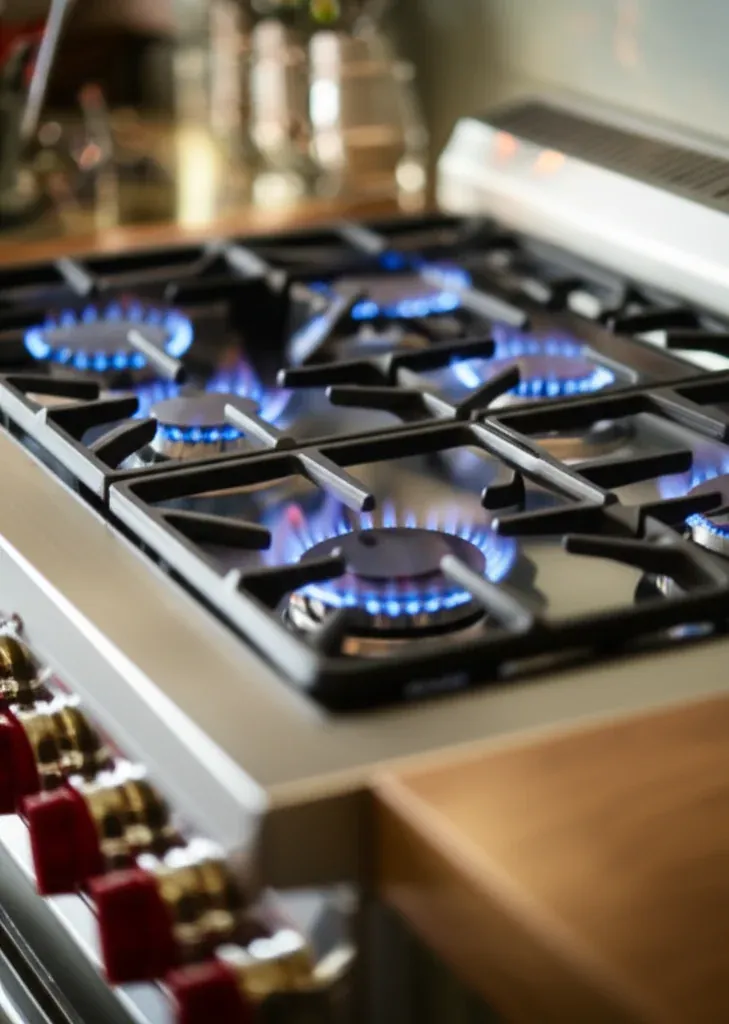
The dual-stack sealed burner is the part of a Wolf rangetop that generates most of the calls, and most of those calls are one of four things. A burner still ticking away once the flame is up is normally moisture around the electrode, a cap sitting slightly off its seat, or a cracked ceramic on the igniter — not a failed spark module, although a weak module does exist and looks identical from across the kitchen.
A burner that lights on high and drops out on simmer is the inner ring of the stack: a partially blocked port, a cap that has been washed and reseated wrong, or a regulator matter if every burner does it at once. Yellow tipping and sooting is an air or gas quality question rather than a component failure, and it is worth resolving before anything is replaced.
The order that saves money is dull but reliable: cap seating and port cleaning first, electrode condition and spark gap second, module and valve last. Anyone naming a part before those three have been looked at is guessing.
Safe to check before calling
- Burner caps seated flat and the right cap on the right burner — they are not interchangeable
- Ports clear of spillover, cleaned dry with the gas off
- Whether one burner misbehaves or all of them do
- A gas smell is not a repair question — shut the supply and call the gas utility first
Ovens
Slow to preheat, running off temperature, dead after a clean
On a gas oven, the classic fault is a glow-bar igniter that has weakened past the point where the safety valve will open for it, while still glowing away as though nothing were wrong. The oven takes an age to light or never does, and the igniter looks perfectly healthy to the eye. It is settled with a clamp meter on the igniter circuit, watching what it actually draws while the valve decides whether to open — a measurement, not an opinion.
On a dual-fuel or electric oven, an oven that bakes unevenly or sits below its set point is far more often the temperature sensor drifting or a relay on the control board than the element, which usually fails visibly and completely. Convection adds the fan motor and its own element to the list. Wolf ovens hold a calibration offset in the control, so an oven that has always run a little cool may need adjusting rather than repairing — but that is proved with a probe over a full cycle, not from the display.
A wall oven that has gone completely dead immediately after a self-clean cycle is nearly always the thermal fuse or the door latch mechanism, both of which are consequences of the clean cycle rather than coincidences.
Useful to have to hand
- Model and serial from the frame — visible with the door open, on the left-hand side on most units
- Whether it is gas, dual-fuel or all-electric
- Whether the fault appeared after a self-clean cycle
- What the display shows, word for word, including any code
Why it differs
What makes a Wolf diagnosis its own thing
Three things separate this equipment from a mainstream range. The controls are platform-specific, so a symptom that means one thing on an older unit means something else on a current one and the model number has to come first. The build is heavy and serviceable — panels, knobs, island trim and grates come off and go back, which means most work happens in place rather than by pulling the unit out. And the parts are supplied to the manufacturer's specification, which matters most on igniters, sensors and gaskets where a near-enough substitute produces a near-enough result.
The other reason to treat it as one family: in this part of Greater Boston the Wolf equipment and the Sub-Zero cabinet next to it were usually bought and installed at the same time, so they age at the same rate. If the range is on its second decade, the refrigeration is too — and the refrigeration side is the core of what this line does.
From here
The rest of the kitchen
- Refrigerator repair Columns and over-under built-ins: warm sections, noisy condensers, water at the toe kick.
- Ice maker repair Fill valves, frozen supply lines, stalled harvest cycles and clear-ice machines.
- Sub-Zero error codes and alerts What the panel on the refrigeration side is trying to tell you, and what to write down.
- Contact and booking Phone or the booking page — hours, and what to have ready before you call.
In their words
From the refrigeration side of the book
4.9 out of 5 across 938 reviews.
5 out of 5
Booked in the evening, seen the following day. Ice was creeping up the drawer sides because the seal had hardened. New gasket and a quick alignment, and he wiped the tracks out before leaving.
5 out of 5
The supply line had frozen where it runs through an unheated wall. He thawed it, insulated that stretch, and told me plainly it would happen again if we shut the cabinet door in a cold snap.
5 out of 5
Our column sits in a tight cabinet run in a Cape up off Hillside and I fully expected the panel to get scratched. He eased the whole unit forward on sliders, found a failed door heater letting the seam sweat, changed it, and put everything back square by lunch.
Booking
Describe what the Wolf is doing
Two minutes on the phone with the model number usually narrows a Wolf fault to two or three causes before anyone is dispatched.
Flat $95 service call, credited against an approved repair. Details on the contact page.