Refrigerator Repair
Sub-Zero vs Other Built-In Refrigerators: What Differs at Repair Time
Every built-in in this bracket cools well when new. The differences that matter arrive in year eight — how the cooling is split, where the machinery sits, how the electronics are divided, and whether the part is still made.
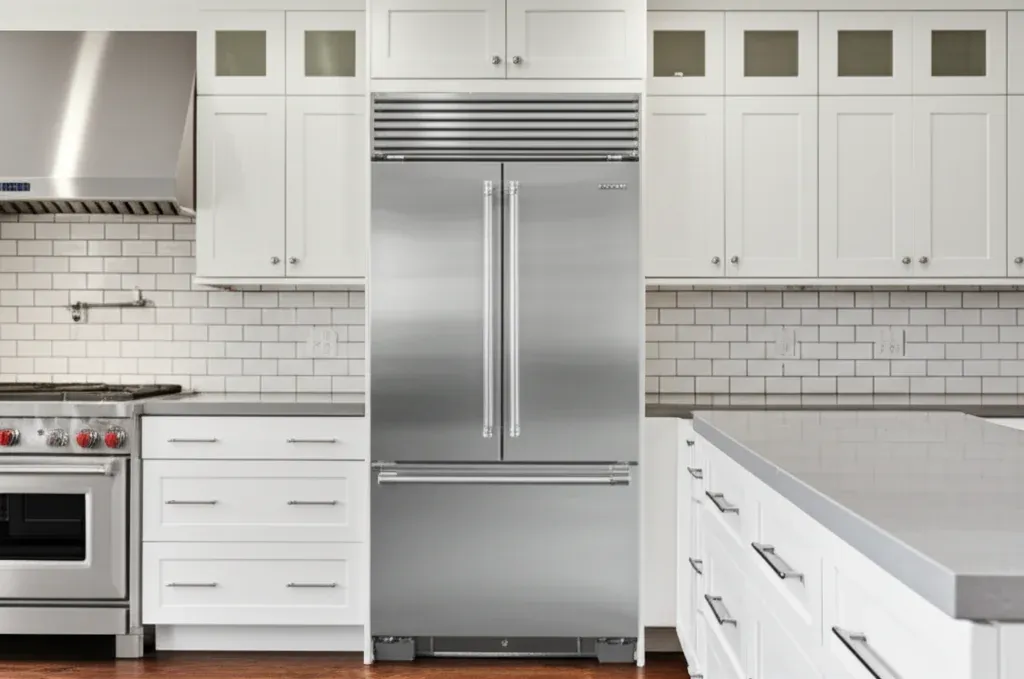
Nothing separates these refrigerators in the first five years. They all hold temperature, they are all quiet, and the showroom comparison — capacity, shelf material, water dispenser, the noise the door makes — describes a period during which none of it matters. The differences worth choosing on show up in year eight, when something fails, and they come down to four things: whether the cooling is split into two circuits or one, where the machinery lives and who can reach it, how the electronics are divided up, and whether your model’s parts are still being made.
Here is how each of those behaves when a technician is standing in front of the cabinet.
One sealed system or two
The classic Sub-Zero built-in runs two independent refrigeration circuits, one for the fresh-food side and one for the freezer. Most competing built-ins run a single circuit and move cold air from the freezer evaporator into the fresh-food compartment through a controlled damper. Integrated columns of any make are single-purpose by definition: the whole cabinet is a refrigerator, or the whole cabinet is a freezer.
At repair time this is the most consequential difference on the list, because it changes what a symptom means.
On a dual-circuit cabinet, “the fridge is warm and the freezer is fine” is an ordinary, self-contained fault: one circuit’s evaporator, fan or control is at fault, and the other side keeps working throughout. The food in the freezer survives the wait for a part. On a single-circuit cabinet the same complaint usually points at the damper, the evaporator fan or the defrost circuit — often cheaper to fix, but it is one system, so when it genuinely fails, the entire cabinet is out.
Neither design is better in the abstract. The dual arrangement contains the damage and doubles the machinery; the single arrangement halves the machinery and concentrates the risk. What you should not do is compare them on the specification sheet, where “dual compressors” reads as a feature rather than as a choice about failure.
Where the machinery lives
Look for the grille. On a classic Sub-Zero built-in the machine compartment is at the top, behind the grille above the doors. On many other built-ins and on nearly all freestanding units it is at the bottom, behind the toe kick.
For anyone who owns the appliance, this decides how the single most valuable piece of maintenance gets done. A condenser at the top is cleanable from a step stool with a soft brush and a vacuum, twice a year, without touching the cabinetry. A condenser at the bottom, in a run of fitted units, is reachable only through a narrow toe-kick opening — and in practice the deep clean it needs usually waits for a visit.
That matters because a clogged condenser is the quiet cause behind a substantial share of what gets reported as a cooling fault. The compressor runs longer, the temperature drifts up in warm weather, and every component in the circuit works harder than it was designed to. Where the grille sits is not a trivial layout decision; it decides whether the maintenance actually happens.
The other half of this is clearance. Whichever end the machinery lives at, it rejects heat into the cabinetry around it, and a unit boxed in tight on three sides without the specified gap runs hot regardless of brand. In the Needham kitchens where a column was fitted into an existing run during a renovation, this is worth checking before blaming the appliance.
How the electronics are divided
The third difference is invisible from the front. Some built-ins put nearly everything on one main control board: compartment control, defrost timing, fan speeds, the display, sometimes the ice maker. Others split those functions across a main board and smaller modules.
The consequence at repair time is simple. Where the functions are partitioned, a failure replaces a module. Where they are consolidated, the same failure replaces the board that runs the cabinet — $520 to $870 either way, but on a consolidated design more faults route to that one part.
There is a diagnostic consequence too. A partitioned system usually gives up more information: the fault is isolated to the module that owns the function. A single board that misbehaves can present as several unrelated symptoms at once — an ice maker that stopped, a fan that will not idle, a display reading nothing unusual — and the temptation is to chase each of them separately. Ask, of any unit you are considering, what one board controls. The answer is in the service literature and no salesperson will have it to hand.
The year-fifteen question
The difference that ends up costing the most is the dullest one: whether a part can still be bought.
Built-in refrigeration is expected to last a very long time, and a cabinet is only serviceable while its parts exist. Two patterns show up. A manufacturer that keeps a platform in production for many years, with parts that carry forward between generations, leaves you able to repair a fifteen-year-old unit with a new part. A manufacturer that re-engineers its line every few years leaves you hunting a discontinued control board on the used market, where the part has an unknown history and no meaningful warranty.
This is not a brand argument, because it varies by generation within a brand. It is a question to ask about the specific model in front of you: how long has this platform been in production, and is the control common to more than one model? Any supplier serving independent shops can answer it, and the answer tells you more about the cost of owning the appliance than the door finish does.
Panels, hinges and the opening
A built-in is a cabinetry decision wearing an appliance’s clothes. The opening was cut to a width and height, the doors were built to a panel thickness, the hinge side was fixed and the water line was run to one particular spot. Those constraints do not travel between makes, and often not between generations of the same make.
It is why the repair-or-replace arithmetic on a built-in looks nothing like it does on a freestanding refrigerator. A typical 36 to 42-inch Classic built-in is $11,600 to $16,800 for the appliance alone, before delivery and installation, and custom panels and integrated cabinetry add roughly $2,000 to $5,000 on top. A column replacement is usually two purchases, refrigerator plus freezer, not one.
Against that, the repairs: $320 to $650 for an evaporator or condenser fan motor, $290 to $710 for a defrost heater, thermostat or sensor, $520 to $870 for a control board, and $980 to $2,130 at the top of the range for compressor or sealed-system work. Even the worst of those is a fraction of the cabinetry job, which is why a built-in is worth repairing years past the point where a freestanding unit would be sent to the kerb.
What to ask, and when to call
Four questions cover it in a showroom: is the cooling split or shared, where is the condenser and can I reach it, what does the main board control, and how long has this platform been in production. Anything else on the specification sheet is preference.
If the question is not which to buy but whether the one you own is worth keeping, that is answered by measurement rather than by opinion — what the circuits are actually doing, what the condenser looks like, and whether the fault sits in the fan-and-sensor group or in the sealed-system one. The visit and full diagnosis is a flat $95, credited against the repair once you approve it, and it produces the one number the buy-or-repair decision has been missing. Ring with the model and serial from the plate inside the cabinet, or use the booking page.
Also asked
Is a counter-depth freestanding refrigerator the same thing as a built-in?
No, and the difference is structural rather than cosmetic. A counter-depth unit is a freestanding appliance made shallow enough to sit close to flush with the worktop; it still stands on its own, still breathes at the back and bottom, and is designed to be pulled out and replaced. A built-in is fixed into the cabinetry, carries its own trim or a panel matched to the doors, and vents through a grille. They look similar in a photograph and they are entirely different to service and to replace.
Does dual refrigeration mean twice the repair bills?
Not in practice, because the two circuits do not fail together. What it means is that any one failure takes out half the cabinet rather than all of it, which is why a warm fresh-food side above a perfectly cold freezer is a normal presentation on these units. It also means two condensers wanting the same annual clean, so the maintenance is genuinely doubled even where the repairs are not.
The kitchen is already cut for one brand. How much does that constrain me?
More than most people expect. The opening width and height, the panel thickness the doors were built to, the hinge side and the position of the water line were all decided when the cabinetry went in. Staying within the same family and the same size class usually means a swap; changing family often means a joiner as well as a delivery. Measure the opening and find the panel specification before falling for anything in a showroom.