Refrigerator Repair
Sub-Zero Wrench Symbol: What the Service Icon Is Telling You
The wrench on a Sub-Zero refrigerator is the service icon: the control has found a fault it cannot clear, often a section that will not hold temperature or a sensor reading out of range. Check temperatures, try one power reset, and book service if it returns.
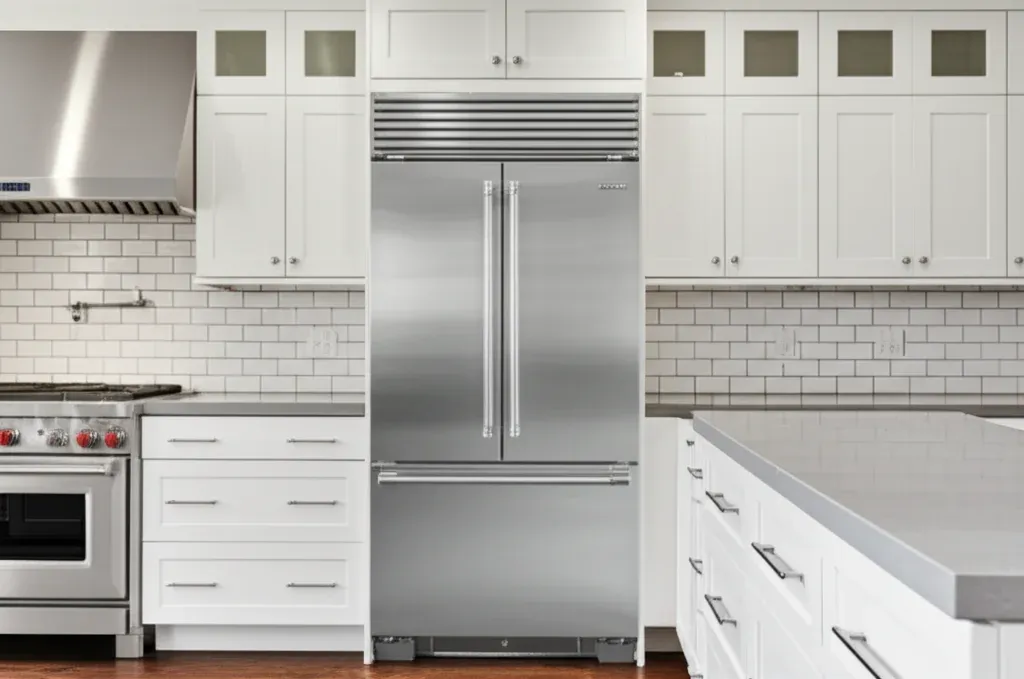
The wrench on a Sub-Zero refrigerator is the service icon. It lights when the electronic control has measured something it cannot correct by itself, most often a section that will not return to its set point (38°F is the usual fresh-food setting, 0°F the usual freezer setting) or a sensor sending a reading that makes no physical sense. It is a request to look, not a shutdown, so the unit normally keeps running. Silence the chime, check real temperatures with a thermometer, try one five-minute power reset, and if the wrench comes back, the fault is real.
How the control decides to light the wrench
A Sub-Zero is not one cold box with a vent between sections. Most models use what the company calls Dual Refrigeration: the fresh-food side and the freezer each get their own cooling system, which keeps freezer air free of food odors and stops frozen coils from drying out the refrigerator air. Each system has its own sensors, and the control board compares their readings with your set points around the clock.
The board expects a pattern. A door opens, the temperature rises, the compressor and fans run, and the section recovers within a predictable time. When recovery drags on, when a sensor reports an unlikely value, or when a fan or defrost cycle fails to produce the change it should, the board stores a fault and turns on the wrench.
Because the systems are separate, one side can fail while the other works perfectly, which is why the wrench often appears on a unit with a rock-hard freezer and warm milk. On 200 and 300 Series combination models, count the 1s in the model number: a 361RFD has one compressor and control, a 3211RFD has two, and the 211 is the exception with just one. PRO Series models split things three ways, giving the main compartment, its drawers and the freezer independent settings adjusted from two touch displays on the grille.
A steady wrench with a chime: the first hour
Go down this list and stop as soon as one item explains the icon:
- Press the alarm key to quiet the chime. The wrench stays lit, which is expected.
- Set one thermometer in a cup of water in the fresh-food section and tuck another among frozen packages. Read both after two or three hours.
- Check every door and drawer. A wedged bottle or a folded gasket lets in warm, damp air faster than the system can remove it.
- Look at the grille. Anything stacked against it, or a mat of dust behind it, starves the condenser of air.
- Listen. A healthy unit hums and you can hear a fan. Silence with a warm cabinet is worth noting.
- If nothing explains it, turn the unit off at its control or the breaker, wait about five minutes and turn it back on.
A reset clears faults left by one-off events, such as a short power cut. If the wrench returns within a day, the board has found something a reset cannot fix.
Why panelled built-ins see the wrench more often
Many Needham kitchens have large integrated columns or classic over-and-under built-ins finished with wood panels that match the cabinetry. Sub-Zero points freestanding or partly exposed installations toward the Classic line and offers Designer units for a seamless cabinet look; either way the sides and back are boxed in, so the unit breathes only through its grille. Renovation dust, a dog that naps by the toe kick, or new trim that half covers the grille all heat the air around the condenser. The compressor runs longer, recovery slows, and the control eventually logs it. Our note on how often to clean condenser coils covers the cheapest prevention.
The other symbols you may see on the panel
Panels vary by series and year. The Classic panel, sold as the Built-In series until Sub-Zero renamed its lines in March 2019, is the one most owners describe. Not every unit has every icon.
| Icon | What it is saying | What you can check | When to call |
|---|---|---|---|
| Wrench | The control logged a fault | Temperatures, doors, grille, one reset | It returns after the reset |
| Chime alone | A door or drawer stayed open | Close it, inspect the gasket | It chimes with doors shut |
| Ice maker | Ice production is on | The water supply valve | Still no ice after two days |
| Air purification | The cartridge is due | Replace it about yearly | Not needed, it is a reminder |
An empty in-unit ice bin can take about two days to refill, because the ice maker drops roughly 8 cubes every two to three hours and stops once the bin is full, so a slow refill after a reset is not a fault. The air purification cartridge holds a small mercury lamp, so a spent one goes to proper disposal rather than the kitchen bin.
What a technician checks, and typical ranges
A visit starts with the fault memory, which shows which section and component the board objected to. After that it is measurement: sensor resistance against actual temperature, fan motors under load, the defrost heater and its circuit, the control board’s outputs and, last, the sealed system. Our page on Sub-Zero error codes and service alerts explains how those readings fit together.
Coming out to find the fault costs a flat $95, and that amount is taken off the repair once you say yes to it. Typical ranges for the usual causes behind a wrench, with the firm quote given after diagnosis:
- Defrost heater, thermostat or sensor: $290–$710
- Evaporator or condenser fan motor: $320–$650
- Electronic control board: $520–$870
- Compressor or sealed-system repair: $980–$2,130
Sealed-system work is never a weekend project. Current Sub-Zero guides warn that these appliances contain a flammable refrigerant and that only technicians qualified to handle it should open the system.
Before you call: the serial tag and a short history
Look for the serial tag first. Classic, 600, 500 and 200/300 Series over-and-under units carry it just inside the fresh-food door, up by the top hinge. A side-by-side has it behind the freezer door, and a Designer Column unit within the middle drawer. Note the model and serial numbers, which section felt warm and roughly when the wrench first appeared.
Sub-Zero Repair Needham works in Needham Heights, Needham Center, Dover and Westwood, using factory-approved parts. Call (617) 610-6886 or book online; our refrigerator repair page explains what a visit covers.
Also asked
Can I keep using my Sub-Zero while the wrench symbol is lit?
Usually yes, for a short while, as long as the fresh-food side stays at or below about 40°F and the freezer stays close to 0°F. Leave an appliance thermometer in a cup of water for a few hours and check what it says. If either section keeps climbing, move perishables to a cooler and call rather than waiting it out.
Will turning the refrigerator off and on clear the wrench?
A power reset clears it only when the fault came from a one-off event, such as a brief outage or a door left open overnight. Switch the unit off at its control or the breaker, wait about five minutes, then switch it back on. If the wrench reappears within a day, the control has found a genuine fault that needs reading.
Is the wrench the same as a filter or air purifier reminder?
No, replacement reminders have icons of their own and simply count time or water use. The air purification cartridge, for instance, is meant to be swapped roughly once a year. The wrench is different in kind: it lights because the control measured something wrong, not because a calendar ran out.
What should I have ready when I call about the wrench?
Have the model and serial numbers from the serial tag, which on over-and-under models is usually just inside the fresh-food door, up by the top hinge. Add which section felt warm, whether a chime sounded and when the icon first showed up. That short history narrows the diagnosis before anyone removes a panel.