Note
Thermador Oven Not Heating Evenly: What the Pale Side Tells You
Uneven baking is a location problem before it is a parts problem. Where the food stays pale — back, one side, everywhere, or only the lower rack — separates a failed bake element from a convection fan, a drifting sensor and a door that has stopped sealing.
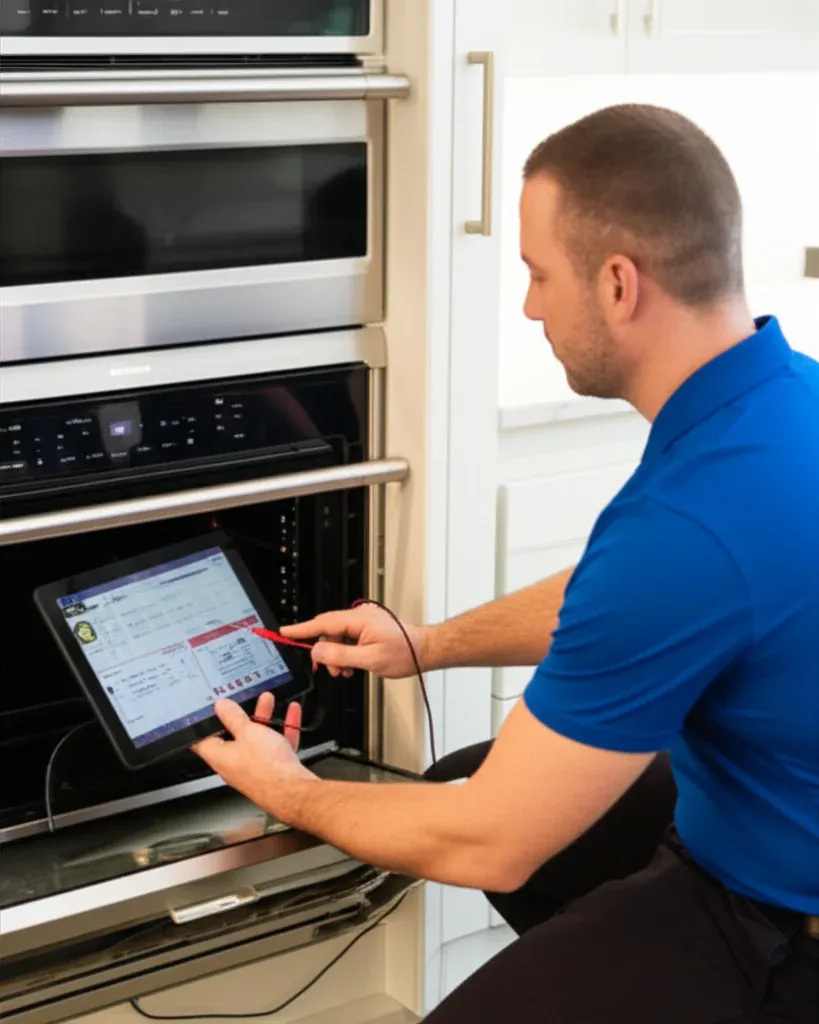
An oven that bakes unevenly is telling you where the heat is missing, and the location — not the size of the error — picks the part. Pale at the back with a good colour at the front is a door and airflow story. Pale down one side is an element or a fan. Everything pale, everything slow, no gradient anywhere, is the cavity sensor or the calibration sitting behind it. A lower rack that stays raw while the upper one browns hard is convection that has stopped distributing. Four patterns, four different jobs, and a tray of shortbread separates them faster than any meter.
Two non-faults get ruled out first, because between them they account for a good share of the calls that end with nothing replaced. The first is loading too early. The ready tone comes from a sensor reaching its set point, not from the walls, the racks and whatever stone or steel is sitting inside reaching it — give the cavity twenty minutes past the tone before anything goes in. The second is a full oven. Three loaded racks, or one tray that runs edge to edge, blocks the path the heat was going to take, and the result looks exactly like a failed component.
Bake something flat and identical
Diagnosis needs a repeatable load, not last Sunday’s roast. Cut plain white bread into slices, or roll shortbread to one thickness, and cover a single sheet corner to corner. One rack, middle position, static bake, nothing else in the cavity. Full preheat plus the soak. Then bake until the first piece colours and take the whole tray out at once.
Photograph it before anyone eats it. The tray is the only record you will have of how this oven behaved on a particular day, and it is worth far more down the phone than an adjective. On a double oven, run the same tray in the other cavity on another day: two ovens sharing one control and one power feed, behaving differently, narrows the field enormously before a technician arrives.
Reading the tray
- Pale at the back, correct at the front. Heat is leaving somewhere it should not, or arriving unevenly. Door seal, hinge sag and the glass pack come first; a blocked or slowed convection path second.
- Pale down one side. Something on that side is not contributing. On an electric cavity that is usually one end of the bake element or a convection fan no longer throwing air the way it did.
- Even colour, but far too little of it, and slow with it. No gradient means no local fault. The cavity is running cool overall, which is a sensor reading high, a calibration offset somebody dialled in years ago, or reduced power to the element.
- Upper rack browning hard, lower rack raw. Radiant heat from above is doing all the work. Convection element, convection motor, or the fan turning too slowly to circulate.
- Colour that moves between bakes. A door that seals sometimes, a latch that does not always pull home, or a control cycling erratically. Intermittent patterns are worth three dated photographs rather than one.
The four components behind those patterns
The bake element is the simplest of them and the least common cause of unevenness, because a broken element usually stops working outright rather than working badly. Where it does cause a gradient is at the ends and at a blistered section, and on the ovens where the element is exposed you can watch it: it should come up to colour along its whole length within a minute or so, evenly. On current Thermador cavities the bake element is often concealed beneath the oven floor, which removes that test entirely and is one reason these get misdiagnosed by eye.
The convection system is two parts that fail separately. The ring element behind the rear baffle can go while static bake carries on perfectly, which produces an oven that heats but never evens out. The motor is the other half: a fan turning slowly, or a blade loose on its shaft, moves a fraction of the air it should and the cavity reverts to radiant behaviour. Listen through a preheat with the room quiet — a convection fan that has changed its note is worth mentioning.
The cavity sensor is a resistance probe, usually in an upper rear corner, and it drifts rather than dies. A probe reading high tells the control the oven is hotter than it is, the control shortens the heat, and everything comes out pale and late with no gradient at all. A technician reads that probe against the manufacturer’s resistance chart at a known temperature, which is the difference between proving it and swapping it.
The door is the one people discount, and it changes both the gradient and the run time. A hinge that has softened, a gasket gone hard at the corners, or a glass pack that has shifted, all leak heat at the front — and a cavity losing heat at the front is a cavity that browns unevenly and cycles constantly to keep up. Close the door on a strip of paper at eight or ten points around the frame. Where it slides out with no resistance, the seal is not loading.
What you can check without tools
Take the racks out and look at the floor of the cavity: foil laid down to catch spills blocks airflow and reflects heat back at the element, and it produces every symptom on the list above. Check that a baking stone has not been left in permanently, because it will absorb heat all through a preheat and hand it back where you did not ask for it. Confirm the oven is level, front to back and side to side — a cabinet that settled after a floor was refinished tilts everything on the rack.
Then look at the settings before the hardware. Somebody at some point may have entered a temperature offset to chase a recipe, and it stayed. Reset it to zero and re-run the tray. If a reliable oven thermometer then reads consistently low at two different rack positions by the same margin, an offset is the correct fix. If the two positions disagree with each other, it is not.
When it stops being a baking problem
Three things move this off the tray and onto the phone. A gas smell around a rangetop burner or the oven vent, at any strength, means stop and ring from outside the room. An oven that is barely warm rather than merely uneven can be a 240-volt circuit that has lost one of its two legs — half a double-pole breaker gone, or a burnt connection at the terminal block — and that is an electrical fault wearing an appliance costume. And a cavity that changed character immediately after a self-clean cycle has almost certainly lost a thermal fuse, a latch or a sensor to the heat.
One note on scope, because it saves an appointment nobody wanted. This line is built-in refrigeration, plus the Wolf cooking equipment fitted alongside it in most of these kitchens. A Thermador cavity is not automatically ours — everything above is set out so that the tray does the work whether we ever see the oven or not. Ring, describe what came out of it, and you will be told plainly whether booking a visit is worth your money. If it is, that visit is the flat $95, covering the call and the full diagnosis.
Bring three things to that conversation: the photograph of the tray, the rack position it was baked on, and the model and serial off the data plate at the door frame. That turns a guess into five minutes, and you can start it from the contact page.
Also asked
Can I just correct this with the oven's temperature offset?
Only if the error is the same everywhere. The offset shifts the whole cavity by a fixed amount, so it is the right tool for an oven that runs cool at every rack position and the wrong one for an oven that is cool at the back and correct at the front. Used on a gradient it makes the hot end hotter while the cold end is still cold, and it hides the fault from the next person to look at it. Prove the error is uniform on two rack positions before touching the setting.
Should I bake on convection to even it out?
It is a reasonable test and a poor cure. If convection genuinely evens the tray, the moving air is compensating for a weak radiant element and you have learned something useful. If convection changes nothing, or browns one side harder than static bake did, suspect the convection element or the fan itself rather than the bake element. Either way the underlying fault is still there and still worth naming.
It baked fine until the self-clean cycle — is that a coincidence?
Rarely. A clean cycle runs the cavity far hotter than any recipe does, and that is the load which finds a tired thermal fuse, a door latch, a sensor already drifting or a control that was close to the edge. An oven that came out of a clean cycle baking differently is a fault the cycle exposed, not one it caused out of nowhere, and it is worth describing in that order when you ring.